Global Virtual Care
Market Revenue to Expand at a CAGR of 26.1% During the Forecast Period
(2018–2026), Driven by the Need to Provide Real-Time Healthcare Services
to Patients Located in Remote Areas
Virtual care is a method that includes the treatment of patients suffering from routine healthcare issues with the help of video, audio or written communication. It can also be referred to as virtual visits with the help of communication devices held by patients as well as physicians located in different places. Virtual care methods are mainly used for meetings, consultation regarding regular health issues consultation, and the like. Virtual care consists of the “virtual visits” that are carried out with the help of telecommunication technologies between patients and healthcare providers. The term “virtual” stands for real-time virtualized meetings between patients and doctors from any location.
Patients and healthcare providers can have virtual visits through different platforms such as a videoconference between a doctor and a patient at home, office, or any other location. Virtual care enables patients as well as doctors to interact with each other from any location, which includes different cities, states, and others. Applications of virtual care in healthcare service delivery is increasing due to the flexibility offered by connected devices. In addition, patients prefer virtual care as they get a chance to find qualified second opinions online owing to the availability of a variety of options for choosing doctors as per their requirements. Virtual care is useful for carrying out meetings, consultations, check-ins, and status reports, however, in-depth diagnosis or treatments cannot be carried out using this method. Moreover, virtual care is applicable in the field of disease management that requires constant follow ups, for instance, in case of patients suffering from diabetes, hypertension, and the like.
Virtual
care solutions provide various benefits, such as real-time
communication with healthcare providers or doctors via video
conferencing, which can be beneficial in handling medical emergencies in
remote locations. Moreover, virtual care helps specialists focus on
important cases by providing them access directly to the hospital or to
the patient medication room despite not being physically present.
Virtual care solutions act as go-to-solutions for patients at remote
hospitals, which promotes the availability of better healthcare
facilities for rural communities as and when required. Moreover, virtual
care solutions also allow patients to use their personal devices for
communicating with healthcare providers anytime and from anywhere via
online sessions, which facilitates better access to healthcare
professionals.
 Several players in this virtual care market
have started taking more interest in this market by investing in
partnerships or by launching new solutions. For instance, in July 2018,
InTouch Health, a virtual care solution provider, entered in to a
partnership with NTT Data to provide turnkey solutions that help
healthcare organizations deliver accessible healthcare services, reduce
costs, and optimize care delivery.
Several players in this virtual care market
have started taking more interest in this market by investing in
partnerships or by launching new solutions. For instance, in July 2018,
InTouch Health, a virtual care solution provider, entered in to a
partnership with NTT Data to provide turnkey solutions that help
healthcare organizations deliver accessible healthcare services, reduce
costs, and optimize care delivery.
Another company Zipnosis, a virtual care solution provider, entered into the partnership with American Academy of Family Physicians (AAFP) to provide a virtual healthcare platform to 129,000 members of AAFP and their patients. The virtual care platform from Zipnosis provides an online diagnosis and treatment solution. This platform also allows members of AAFP to connect virtually with their family physician.
Another company Synzi, a virtual care company, entered into a partnership with ClearData, an IT company. This partnership will help Synzi by ensuring the security, privacy, and compliance of its virtual care platform. By leveraging ClearDATA’s HIPAA-compliant and HITRUST-certified solution, Synzi will ensure the security of its technology and its continued regulatory compliance.
Revenue generated by the global virtual care market is estimated to exhibit a double-digit CAGR and reach US$ 13.08 Bn by 2026. On the basis of component, the virtual care market is segmented into solution and services. Revenue contribution from the virtual care solution segment is expected to expand at a CAGR of 26.9% during the forecast period due to the increasing deployment of solutions in different virtual care application areas such as hospitals, pharmacies, and others.
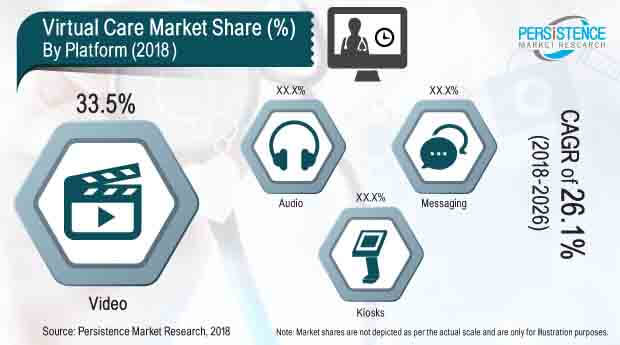
This segment is further divided into virtual care platform types – video, audio, messaging, and kiosks. Among platform type, video platforms are widely used by virtual healthcare providers.
On
the basis of application, the global virtual care market is segmented
into pharmacy, hospital, and others. The hospital segment is further
subsegmented into private hospitals and government hospitals. In the
virtual care market by application, the revenue contribution from the
hospital segment is expected to expand at a CAGR of 27.5% during the
forecast period due to the demand for virtual care services by a large
number of patients.
Some of the key players in the virtual care market are Teladoc, Inc.; Americal Well; AT&T Inc.; MDLIVE Inc.; AMD Global Telemedicine, Inc.; Koninklijke Philips N.V.; CHI Health; United HealthCare Services Inc.; THA Group; and Synzi.
Virtual care is a method that includes the treatment of patients suffering from routine healthcare issues with the help of video, audio or written communication. It can also be referred to as virtual visits with the help of communication devices held by patients as well as physicians located in different places. Virtual care methods are mainly used for meetings, consultation regarding regular health issues consultation, and the like. Virtual care consists of the “virtual visits” that are carried out with the help of telecommunication technologies between patients and healthcare providers. The term “virtual” stands for real-time virtualized meetings between patients and doctors from any location.
Patients and healthcare providers can have virtual visits through different platforms such as a videoconference between a doctor and a patient at home, office, or any other location. Virtual care enables patients as well as doctors to interact with each other from any location, which includes different cities, states, and others. Applications of virtual care in healthcare service delivery is increasing due to the flexibility offered by connected devices. In addition, patients prefer virtual care as they get a chance to find qualified second opinions online owing to the availability of a variety of options for choosing doctors as per their requirements. Virtual care is useful for carrying out meetings, consultations, check-ins, and status reports, however, in-depth diagnosis or treatments cannot be carried out using this method. Moreover, virtual care is applicable in the field of disease management that requires constant follow ups, for instance, in case of patients suffering from diabetes, hypertension, and the like.
A sample of this report is available upon request @ https://www.persistencemarketresearch.com/samples/12499
Another company Zipnosis, a virtual care solution provider, entered into the partnership with American Academy of Family Physicians (AAFP) to provide a virtual healthcare platform to 129,000 members of AAFP and their patients. The virtual care platform from Zipnosis provides an online diagnosis and treatment solution. This platform also allows members of AAFP to connect virtually with their family physician.
Another company Synzi, a virtual care company, entered into a partnership with ClearData, an IT company. This partnership will help Synzi by ensuring the security, privacy, and compliance of its virtual care platform. By leveraging ClearDATA’s HIPAA-compliant and HITRUST-certified solution, Synzi will ensure the security of its technology and its continued regulatory compliance.
Revenue generated by the global virtual care market is estimated to exhibit a double-digit CAGR and reach US$ 13.08 Bn by 2026. On the basis of component, the virtual care market is segmented into solution and services. Revenue contribution from the virtual care solution segment is expected to expand at a CAGR of 26.9% during the forecast period due to the increasing deployment of solutions in different virtual care application areas such as hospitals, pharmacies, and others.
This segment is further divided into virtual care platform types – video, audio, messaging, and kiosks. Among platform type, video platforms are widely used by virtual healthcare providers.
Request for Methodology at: https://www.persistencemarketresearch.com/methodology/12499
Some of the key players in the virtual care market are Teladoc, Inc.; Americal Well; AT&T Inc.; MDLIVE Inc.; AMD Global Telemedicine, Inc.; Koninklijke Philips N.V.; CHI Health; United HealthCare Services Inc.; THA Group; and Synzi.

No comments:
Post a Comment